Governed Autonomous Intelligence for Offline & Degraded Environments
Built for field reality. Offline-first architecture with deterministic governance and recovery. Designed for defense, robotics, emergency response, and mission-critical systems operating without reliable connectivity.


See ARIA In Action
TRL 6 validation, stress testing, and autonomous recovery in real-world environments
API Endpoint Stress Test
Watch 800+ endpoint validation with autonomous recovery and real-time resilience monitoring.
Autonomous Recovery Demo
Multi-phase recovery with soft and hard verification paths in degraded network conditions.
Governance & Policy Engine
Weighted voting, policy enforcement, and deterministic governance in mission-critical workflows.
Autonomy & Control Model
AI does not execute actions by default. AriaOS operates in Human-In-The-Loop (HITL) mode unless a constrained autonomy profile is explicitly enabled by an authorized operator.
- Human approval is required for all actions unless constrained autonomy is explicitly configured
- Autonomous execution is profile-gated, policy-enforced, and continuously audit-verified
- Loss of audit integrity automatically disables autonomous execution and reverts to HITL mode
- All AI recommendations include explainable reasoning, uncertainty bounds, and reversibility metadata
Why ARIA Exists
Current AI infrastructure fails where it matters most.
The Problem
- Cloud-dependent AI fails in contested environments
- Probabilistic outputs fail mission-critical ops
- Third-party processing fails data sovereignty
- Most AI demos, few deployable systems
The Solution
- Never phones home - zero external dependencies
- Deterministic recovery - predictable failure handling
- Sovereign compute - data never leaves your hardware
- Field-validated - 800+ endpoints stress tested
Who ARIA Serves
Purpose-built for organizations where mission failure is not an option.
Government & Defense
DoD, Intelligence Community, DHS, FEMA, NASA, DOE. Sovereign AI for contested environments, DDIL operations, and national security missions.
Explore Government Solutions →Enterprise
Healthcare, Energy, Manufacturing, Finance. AI that runs on your infrastructure, never phones home, and stays up when everything else fails.
Explore Enterprise Solutions →Operators & Technologists
Field operators, analysts, engineers, and leadership. Understand how humans stay in the loop while ARIA handles the system complexity.
See How Humans Use ARIA →Before & After ARIA
What changes when you deploy sovereign autonomous intelligence.
Before ARIA
- Cloud-dependent AI fails when connectivity drops
- Data leaves your perimeter for third-party processing
- Single points of failure cascade across systems
- Pilots that demo well but never deploy
- Tool sprawl: 12+ systems, none talking to each other
- Manual intervention required for every edge case
- Compliance theater vs. actual security
After ARIA
- Full autonomy in DDIL environments with operator governance
- Data stays on your hardware—zero cloud dependencies
- Deterministic recovery with multi-phase detection and isolation
- Production-ready governance engine with audit trails
- Unified agent coordination across distributed systems
- Autonomous execution within policy bounds, escalation when needed
- Pre-LLM compliance layer enforces policy before model inference
How ARIA Works In The Field
A unified intelligence layer that coordinates sensors, systems, and decisions.
Ingest
Sensors, feeds, logs, APIs—all normalized into the Context Kernel
Analyze
Multi-agent orchestration processes data through specialized AI agents
Decide
Pre-LLM compliance validates actions before execution
Act
Autonomous execution or human handoff based on policy thresholds
Core Capabilities
Purpose-built for environments where connectivity is a liability and failure is not an option.
Kernel Integrity Under Chaos
Context Kernel v3 maintains deterministic state management through agent crashes, memory pressure, and network partitions. Verified through 800+ endpoint stress tests.
Multi-Agent Orchestration
Supervisor-authorized agent spawning and lifecycle management. Agents communicate through shared memory bus with role-based execution within governance boundaries.
Deterministic Recovery Paths
Autonomous healing loops detect anomalies, isolate failures, and restore operations without human intervention. Recovery time measured in milliseconds, not minutes.
Offline-First Autonomy
Zero cloud dependencies. Full operational capability in denied, disconnected, intermittent, and limited (DDIL) environments. Your data never leaves your hardware.
Sovereign Compute Principles
Hardware-agnostic deployment across Apple Silicon (MLX), NVIDIA (CUDA/TensorRT), and x86. Optimized for edge deployment with predictable resource utilization.
Pre-LLM Compliance Layer
Policy enforcement happens before model inference. Unsafe operations are blocked at the kernel level, ensuring alignment with mission parameters and ROE.
System Architecture
A unified framework for autonomous intelligence that doesn't depend on hope.
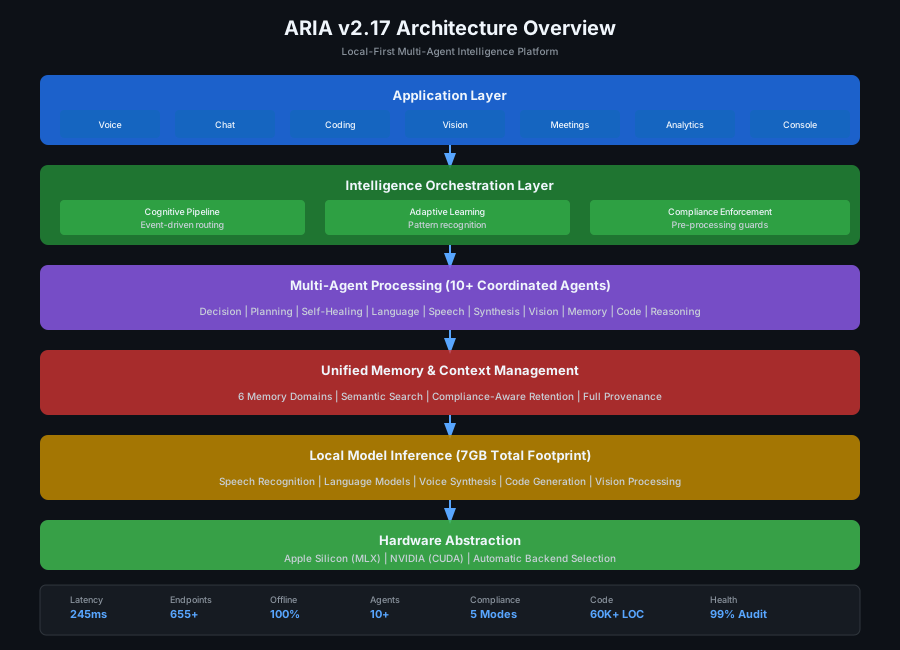
High-level architecture showing the Context Kernel, Memory Bus, and Agent Orchestration layers.
Mission Profiles
ARIA operates across domains where autonomous intelligence is mission-critical.
Defense & Intelligence
Tactical autonomy for unmanned systems, ISR processing, and multi-domain C2. Operates in DDIL environments without reach-back requirements.
Robotics & Automation
Embedded intelligence for autonomous vehicles, industrial robotics, and warehouse automation. Real-time decision making at the edge.
Emergency Response
First responder support systems for disaster scenarios. Operates when infrastructure fails and connectivity cannot be assumed.
AriaOS is undergoing ongoing resilience and governance research in safety-critical environments.
AriaOS Resilience Snapshot
Most teams assume resilience exists because nothing failed yesterday. Get an offline assessment of what happens when connectivity stops behaving—before reality forces the conversation.
Offline analysis • No integration required • Data never retained
Ready to See ARIA in Action?
Schedule a demo walkthrough or explore the technical documentation.
Defense or government agency? Certified SDVOSB & VOSB. Ready to support your mission.